Three principles for AI in the enterprise
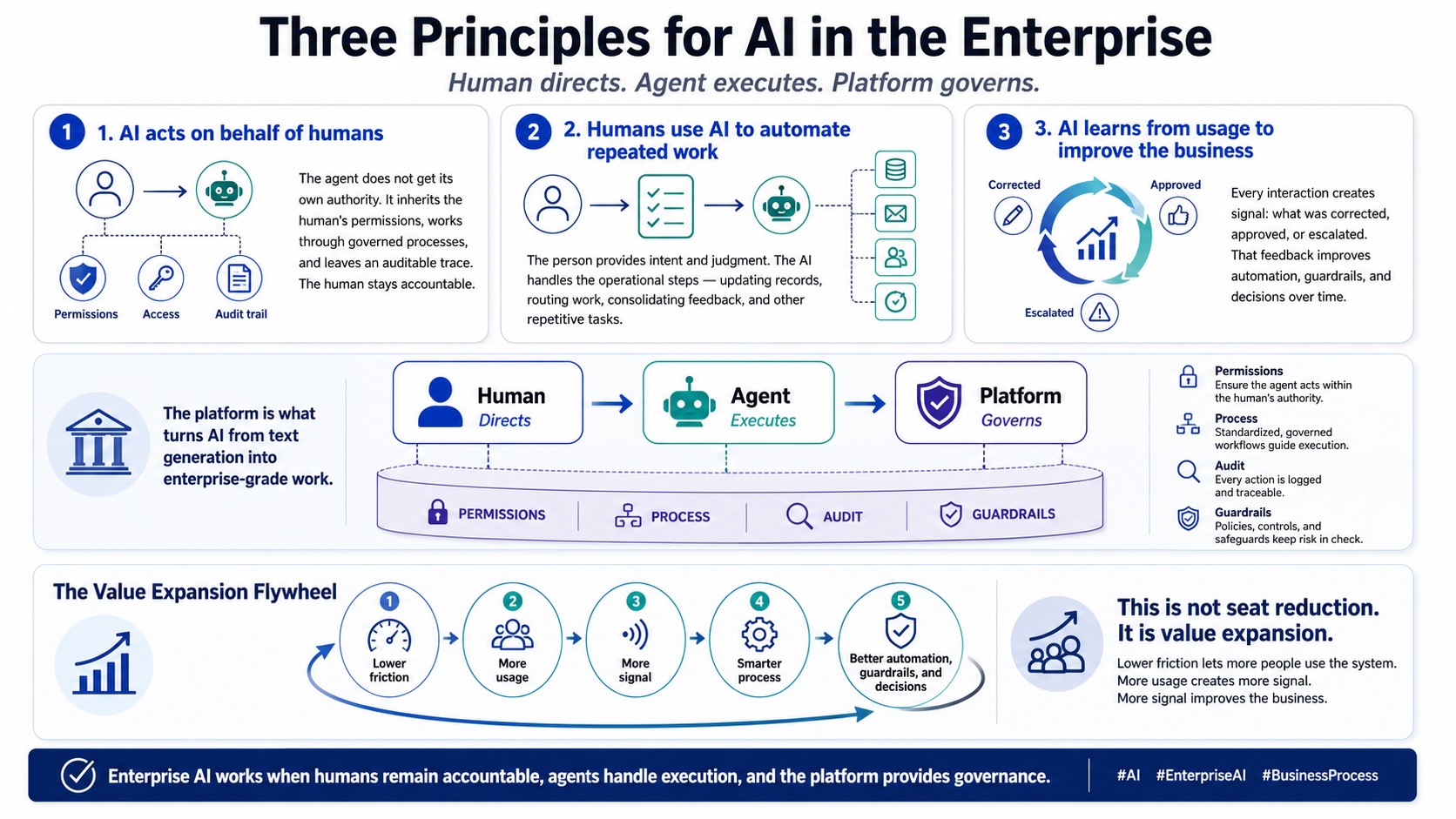
The most useful framing I've seen for AI in the enterprise reduces to three lines:
- AI acts on behalf of humans.
- Humans use AI to automate repeated work.
- AI learns from usage to improve business process and value.
Each one matters because each one solves a different problem most AI conversations gloss over.
1. Acting on behalf — not as an independent actor.
In the enterprise, an agent shouldn't be an unbounded user. It should be a delegate. It inherits the human's permissions. Sensitive actions hit existing approval paths. Every action attributes back to a human, with a trace. The human is elevated from operator to director, coach, and accountable owner — they aren't replaced.
2. Automate repeated work — humans bring intent, AI carries it out.
The win isn't doing the same task faster. It's converting repetitive work into reusable, governed execution patterns. First time, AI helps. Tenth time, it becomes a defined workflow. Hundredth time, it becomes a better process.
3. Learn from usage — feed signal back to improve.
This is the compounding part. When users correct agent output, that's signal. When approvals are routed differently than expected, that's signal. When humans repeatedly override an agent's recommendation in a segment, that means a rule is outdated. The platform becomes a business optimization system, not just a system of record.
The flywheel: more usage → more signal → smarter process → higher trust → more adoption → more usage.
This reframes AI as value expansion, not seat reduction. Lower friction means more people can safely use the system. People who never opened the UI can now access governed workflows through natural language. Seats become more valuable because the work each person does becomes more productive, traceable, and improvable.
The future of enterprise software isn't 'AI replaces UI.' It's 'AI as a trusted execution layer, with humans directing and the platform governing.'
#AI #EnterpriseAI #DigitalTransformation